Most businesses drown in data. They starve for action. Today, data analytics trends focus on making software work for you. Forget old dashboards. Use systems that fix problems before you notice them. Modern agentic AI handles these tasks by acting as a digital worker. You get better results when you use machine learning for decision
Most businesses drown in data. They starve for action. Today, data analytics trends focus on making software work for you. Forget old dashboards. Use systems that fix problems before you notice them.
Modern agentic AI handles these tasks by acting as a digital worker. You get better results when you use machine learning for decision intelligence. Top leaders see 23x better customer acquisition by following these data analytics trends.
They use predictive analytics to stop guessing. It is time to move past visualization. This shift changes how companies use automation and increase AI adoption.
Agentic AI acts like a digital employee that never sleeps. While a chart waits for you to see a problem, these agents find and fix issues immediately. You no longer have to stare at a screen to trigger automation. Instead, the system uses AI models to reason through tasks and reach a goal.
Standard visualization shows you that inventory is low. Agentic AI goes further. It notices the dip, checks supplier prices, and places a restock order. This shift is a key part of current data analytics trends.
JPMorgan Chase uses these tools for fraud detection. Their system achieves 40% better detection by acting on data instantly. It doesn’t just flag a transaction; it correlates behavior and stops theft. This is why AI adoption is growing so fast.
These agents work around the clock to handle tasks, but their true power lies in how they help you make high-stakes choices.
Big AI isn’t always better. Many data analytics trends now favor Small Language Models (SLMs). These AI models are 70% cheaper to run and work faster than massive systems.
They fit your specific business needs without the high price tag. Because they are smaller, you can host them on your own servers to keep your data safe. This improves your data governance and builds trust. These tools are a core part of current data analytics trends.
A general AI knows everything but masters nothing. Using a small model for one task, like medical coding, gives you 92% accuracy. One of the growing data analytics trends is using specialized models to get precise results.
You get better predictive analytics when the system focuses on your data alone. Banks and hospitals use these to improve AI adoption without risking privacy. Agentic AI works best when powered by these efficient tools.
Managing these models is easier when your data isn’t scattered across different systems.
Most companies have data stuck in different places like Salesforce, Excel, or various cloud platforms. This fragmentation makes it hard to see the big picture. A data fabric acts like a net that connects all these sources into one view.
You do not have to move the data physically. Instead, the data fabric uses machine learning to find and link information through automation.
These data analytics trends show that connecting silos is essential for AI adoption. When data flows freely, your AI models perform better. You get real-time analytics that matter. Using a data fabric helps you spot data analytics trends across your whole company.
This architecture supports agentic AI and predictive analytics by giving them a clean path to every record. These data analytics trends change how you handle information.
Connecting your systems is the first step, but speed requires processing data closer to the source.
Edge computing moves processing power directly to where things happen. You see this on factory floors or in delivery trucks every day. Systems handle data locally. This avoids sending raw data to a distant cloud.
This shift is one of the most practical data analytics trends today. You save money because you skip expensive cloud fees. These setups provide real-time analytics in milliseconds. Speed like this is essential for safety.
Many data analytics trends now focus on this “immediacy” to drive profit.
Using edge computing also boosts your automation efforts. You get faster results and better privacy. This is a major reason why AI adoption is hitting record highs. Agentic AI flourishes here. It acts on local data quickly. Following these data analytics trends ensures your business stays fast and lean.
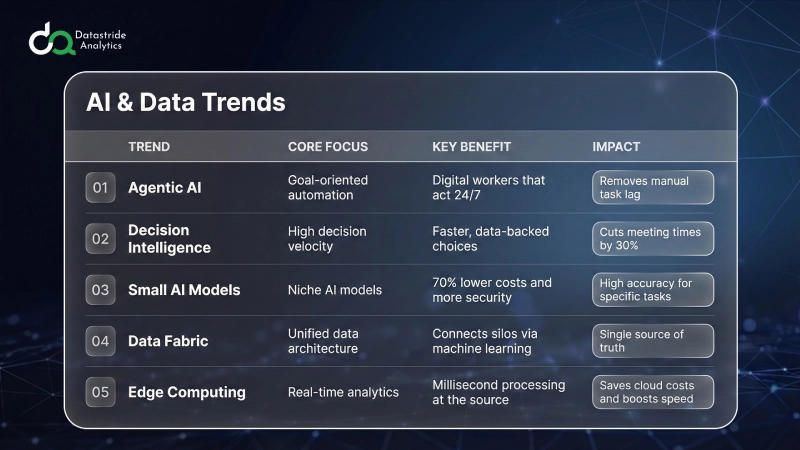
Quick Glance: Top Data Analytics Trends 2026
| Trend | Core Focus | Key Benefit | Impact |
| Agentic AI | Goal-oriented automation | Digital workers that act 24/7 | Removes manual task lag |
| Decision Intelligence | High decision velocity | Faster, data-backed choices | Cuts meeting times by 30% |
| Small AI Models | Niche AI models | 70% lower costs and more security | High accuracy for specific tasks |
| Data Fabric | Unified data architecture | Connects silos via machine learning | Single source of truth |
| Edge Computing | Real-time analytics | Millisecond processing at the source | Saves cloud costs and boosts speed |
Datastride Analytics replaces slow, manual work with Sia, an elite platform for data analytics trends. Sia handles everything from raw data to final reports. You get strategic growth 80% faster than old tools.
By focusing on decision intelligence, Datastride helps you turn logs into profit. This shift boosts AI adoption across your entire team.
Datastride bridges the gap between technical tasks and business goals. Stop wasting time on manual reports and start seeing results with agentic AI today. Explore how Sia automates your enterprise analytics and simplifies your AI adoption → Datastride Analytics.
The 2025 data analytics trends focus on speed and agentic AI. However, most companies still struggle with fragmented data and slow decision intelligence. Relying on old visualization methods leads to massive losses and missed growth.
If you do not modernize, you fall behind competitors who use predictive analytics to win. Lagging in AI adoption means your business becomes obsolete in a fast market.
Datastride Analytics solves this by automating your entire data lifecycle. We help you use machine learning to turn information into action. Stay ahead of the curve and secure your future.
Let’s book a demo with Sia and see how these data analytics trends improve your operations through agentic AI and automation.
Current data analytics trends focus on agentic AI and decision intelligence. You get faster results by using machine learning for real-time analytics. Enterprises now prioritize automation and data fabric architectures to simplify AI adoption and improve overall efficiency.
Unlike static visualization, agentic AI acts on your goals 24/7. It uses advanced AI models to handle tasks like reordering stock or flagging fraud. These data analytics trends allow for instant automation, boosting your decision intelligence without constant human monitoring.
A data fabric connects all your information into one view using machine learning. It eliminates silos and strengthens data governance. Following these data analytics trends ensures your AI models have clean data, leading to more accurate predictive analytics for growth.
Yes. Small language models are a major part of data analytics trends because they offer 92% accuracy for niche tasks. They are cheaper and improve data governance by running locally. Use these AI models to accelerate AI adoption and automation.
Edge computing processes data at the source, providing real-time analytics in milliseconds. This is a key part of data analytics trends for 2026. It reduces cloud costs and enables automation for self-driving trucks or factory floors, improving your decision intelligence instantly.