Discover how AI analytics and data intelligence are transforming enterprise decision-making in 2025 through automation, predictive insights, and real-time data-driven strategy.

AI is no longer a side experiment for business teams. AI analytics now sits at the center of how leaders plan, decide, and act. You deal with fast-moving markets, constant data flow, and pressure to respond without delay. Static reports fail in these conditions.
AI analytics turns live data into clear signals you can trust, helping you move with confidence instead of guesswork. With strong data intelligence, teams see patterns early, spot risks faster, and adjust plans before problems grow.
This shift changes how enterprise analytics supports daily decisions, not just quarterly reviews. This guide explains what’s driving adoption in 2025 and how smarter analytics improves real business outcomes.
Business decisions no longer happen in slow cycles. You face live data, tight timelines, and higher accountability. ai analytics fits this reality by turning constant data flow into clear, usable direction.
This shift explains why decision teams now treat analytics as part of daily execution, not a reporting layer.
Every team works with inputs from multiple systems at once. Manual reviews cannot keep up. ai analytics processes data streams instantly and highlights what matters most, helping you act without delay.
What changes for teams:
Classic dashboards describe past performance. ai analytics focuses on future outcomes. Predictive models surface demand shifts, revenue risks, and operational gaps before they affect results. This approach pushes enterprise analytics beyond charts and summaries.
What leaders gain:
These capabilities set the stage for the advanced features shaping enterprise analytics in 2025.
Enterprise teams expect analytics to guide action, not sit in dashboards. ai analytics meets that expectation through features that support planning, execution, and fast response across business functions.
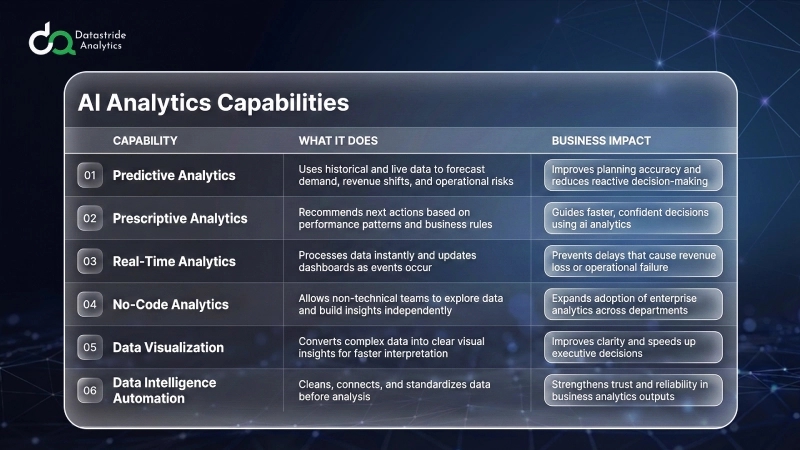
Planning improves when forecasts reflect real behavior patterns. ai analytics applies predictive analytics to historical and live data to estimate demand, revenue movement, and capacity needs. Prescriptive models go a step further by recommending actions based on current performance signals.
Where teams see value:
This shifts enterprise analytics from static planning to active execution.
Delayed insights slow decisions. ai analytics processes data as it arrives and updates dashboards instantly. Teams track operations, supply chains, and customer activity without waiting for scheduled reports.
Practical outcomes:
Real-life example: “A retail operations team tracks store inventory using ai analytics connected to point-of-sale systems. As products sell, dashboards update instantly. When stock drops faster than expected, alerts appear the same day. Managers reorder inventory before shelves run empty. This real-time view replaces weekly reports and keeps enterprise analytics aligned with actual demand.”
Access to analytics should not depend on technical skills. No-code analytics tools let business users build views, ask questions, and explore trends without engineering support. This expands data intelligence across teams and reduces dependency on IT.
Key Capabilities of AI Analytics Transforming Enterprises in 2025
| Capability | What It Does | Business Impact |
| Predictive Analytics | Uses historical and live data to forecast demand, revenue shifts, and operational risks | Improves planning accuracy and reduces reactive decision-making |
| Prescriptive Analytics | Recommends next actions based on performance patterns and business rules | Guides faster, confident decisions using ai analytics |
| Real-Time Analytics | Processes data instantly and updates dashboards as events occur | Prevents delays that cause revenue loss or operational failure |
| No-Code Analytics | Allows non-technical teams to explore data and build insights independently | Expands adoption of enterprise analytics across departments |
| Data Visualization | Converts complex data into clear visual insights for faster interpretation | Improves clarity and speeds up executive decisions |
| Data Intelligence Automation | Cleans, connects, and standardizes data before analysis | Strengthens trust and reliability in business analytics outputs |
These capabilities explain why analytics platforms now play a direct role in daily decision-making across enterprises.
Decisions break down when teams rely on partial, delayed, or inconsistent data. Data intelligence addresses this problem by giving AI analytics reliable inputs and clear context. When data reflects real business activity, leaders spend less time validating numbers and more time acting on them.
Enterprise data often lives across disconnected systems. ai analytics prepares this data before analysis by cleaning records, linking sources, and standardizing formats. This step removes confusion and improves accuracy.
With stronger inputs, enterprise analytics produces insights tied to actual performance instead of assumptions. Teams see patterns that explain what is happening and why it is happening, which supports better planning and execution.
Strong data intelligence shortens reaction time. ai analytics monitors live signals and surfaces risks early. Leaders respond to shifts in demand, cost, or efficiency before they affect results.
This approach supports faster decisions across business analytics workflows. Teams adjust actions using current information, keeping decisions aligned with real conditions and preparing the organization to address adoption challenges more effectively.
Many companies invest in AI analytics expecting fast impact. Results fall short when foundational issues go unresolved. The barriers usually sit below the surface, tied to data structure and decision ownership rather than software capability.
Weak inputs limit output quality. AI analytics depend on consistent, connected data to work as expected.
Common problems include:
Without solid data intelligence, teams question results and delay action, which defeats the purpose of analytics.
Analytics tools fail when they lack direction. AI analytics initiatives often launch without clear decision goals.
Typical gaps include:
Strong adoption links analytics to specific decisions. Clear goals, leadership involvement, and measurable impact keep analytics tied to real business outcomes and set the stage for platforms that simplify execution.
Datastride Analytics helps teams apply ai analytics without complex setups or slow workflows. Our Sia platform brings data ingestion, analysis, and decision outputs into one system, reducing delays and confusion across teams.
What Sia enables:
This approach turns analytics into a daily decision engine instead of a reporting task. Explore how Sia helps your team use ai analytics to make faster, clearer business decisions.
AI analytics now shape how modern teams plan, forecast, and act. It brings speed, clarity, and consistency to decisions that once relied on delayed reports. Problems appear when data stays fragmented, models lack context, or insights arrive too late.
In those cases, enterprise analytics creates confusion instead of direction. Wrong decisions then follow missed demand signals, rising costs, customer churn, and avoidable losses that surface only after damage is done.
This is where structure matters. With strong data intelligence, platforms like Datastride Analytics help organizations turn live data into dependable guidance, supporting better decisions without adding complexity or noise.
Let’s connect with Datastride Analytics and see how ai analytics can support clearer, faster decision-making across your teams.
AI analytics uses automation and machine learning to turn data into data insights that guide decisions. Teams use it for business analytics, forecasting, risk flags, and faster execution. It improves decision-making by replacing delayed reports with real-time, actionable outputs.
Data intelligence improves enterprise analytics by cleaning, connecting, and contextualizing data before analysis. It strengthens data-driven strategy by reducing errors and gaps. With better inputs, ai analytics delivers more reliable predictive analytics, clearer data visualization, and stronger day-to-day decisions.
No-code analytics tools let business teams use analytics tools without coding. They build dashboards, explore trends, and generate data insights quickly. This expands adoption of ai analytics, reduces IT dependence, improves real-time analytics access, and speeds up decision-making across departments.
Common issues include poor data quality, siloed systems, weak governance, and unclear goals. These problems limit AI analytics accuracy and slow enterprise analytics usage. Without strong data intelligence, analytics platform results lose trust, delaying action and weakening data-driven strategy.
Datastride Analytics supports ai analytics through Sia, an analytics platform that automates ingestion, modeling, and data visualization. It improves data intelligence, supports real-time analytics, and offers templates for faster outcomes. Teams get dependable business analytics without heavy engineering cycles.